Surprising Lessons from Formal Logic (Without Doing Any)
Do I contradict myself? Very well then, multi-valued logics to the rescue.


I'll admit it has been hard to find a sexy hook for this one (besides Walt there). Even more than math, logic as a topic seems either dry and esoteric, or so basic that we figure we already have a decent enough handle on it. Not many folks think of themselves as illogical, right?
But trust me: there are exciting things happening in the world of logic. They deserve to escape from academic gatekeeping and become more common knowledge. Luckily, it requires no expertise at all on your part or mine to talk about the existence of these happenings, and only a little other knowledge to talk about what they mean. These developments are building on yet leaping beyond millennia of conventional Euro-Western thinking. They can be quite handy in everyday life. More than that, I and others think they're necessary for more people to be aware of if we're going to have much hope of a reality-based, regenerative future instead of our delulu and degenerate present trajectory.
"Logic" carries a wide range of meanings, but they all center around good or correct reasoning. Logic figures what follows from what and what doesn't. As with the prior math post, I'm not really going to attempt to teach the substance of the subject, although I'll link to some resources for anyone interested. Formal logic gets complicated and jargon-y fast. Keeping this update high-level avoids most of that. I'm also going to save informal fallacies for a future post, though process-relational thinking offers tools to get those consistently less wrong as well. Instead, my main goal here is to use the existence of trends in the domain of formal logic to support conclusions about how the world works and what things are at the most general level. In other words, the goal is to improve the practical everyday metaphysical frameworks that you and I are always already applying any time we think about literally any thing. If the things that constitute the universe are better thought of as relational processes rather than isolated entities with determinate essences, then simply dismissing contradictions as impossible doesn't work. Modern logic increasingly reflects this reality.
Like pretty much any introductory logic course, we'll start with so-called "classical" binary logic. It's a good place to start refining reasoning skills, and I agree it probably should become part of standard curricula well before college. Unlike many such courses, however, we won't end there. That's because, while the dominant mainstream (Euro-Western) thinking about logic has long deemed classical logic to be practically synonymous with logic in general, it's not. There are logics. Plural. And they're not just branches of classical logic like propositional and predicate logic. They reflect and reinforce very different metaphysical understandings of how the world works, and as I and others keep showing, we have massive amounts of convergent evidence that some of those baseline understandings are less wrong than others. It follows that different logics can have different levels of correspondence with reality too. That's why it's worth knowing about some of those other ones that are out there.
The main thing to know about classical logic, whatever the branch or system, is that it's binary, or bivalent. It has two values: true or false. This foundational true/false binary is broken out into several centuries-old "laws," applied across any proposition, P. (A proposition can be any declarative sentence or phrase capable of having some truth-value, like "Madison is the capital of Wisconsin" or "all cats have tails".) These include:
- Law of excluded middle (either P or its negation not-P must be true) and double negation elimination (P = not not P)
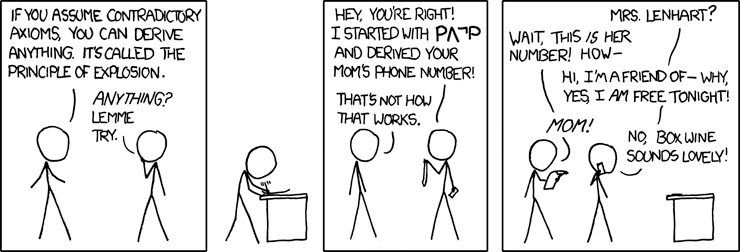
- Law of noncontradiction (P and not-P can't both be true, in the same sense and at the same time) and the principle of explosion (any P at all can be inferred/proved from a contradiction, so a contradiction can't be true or else "anything goes" and the whole logic system breaks)
As the Stanford Encyclopedia of Philosophy summarizes, "Classical logic, and most standard 'non-classical' logics too such as intuitionist logic, are explosive [i.e., premised on contradictions not being true]. Inconsistency, according to received wisdom, cannot be coherently reasoned about." Likewise, introducing the book The Law of Non-Contradiction: New Philosophical Essays, co-editor J.C. Beall declares: "That no contradiction is true remains an entrenched 'unassailable dogma' of Western thought."
However, Beall continues: "In recent years... the 'unassailable dogma' has been assailed."
That brings us to its assailants, along with another crucial thing to know about binary classical logic: how culturally specific it is, despite its hegemonic inertia. When applied to the real world, classical logic both reflects and reinforces the dominant Euro-Western patriarchal map-metaphysics of dualisms, total separability, static essentialism, idealizing abstraction, reductionist determinism, view-from-nowhere "objectivity," control orientation, zero-sum competition, and the ensuing hierarchical power dynamics.
Non-contradiction's proponents have long dismissed alternative perspectives that question that "law" as less "rational," bound by primitive superstition or feminized emotionality that the classically logical have transcended through their clear and consistent rules. But the questioners may just know that when you step outside pre-defined models, the real world's things and properties and defining lines aren't always clear and consistent. They're processual and relational. That can produce fuzziness and inconsistencies worth reasoning about. This does not lead to mushy relativism! Going beyond classical logic, including by referencing Indigenous and intersectional feminist logics, allows us to deal with inconsistency in a way that treats inconsistent information as, well, informative. In the words of logician Zach Weber, "sometimes an inconsistency can be retained, not as some mysterious riddle, but rather as a stone-cold rational view of our contradictory world."
I'll condense (without brackets or ellipses, for readability) passages of a great recent comparison between classical and North American Indigenous non-classical logics, because it so nicely sums up problems with classical logic's rules and begins to introduce ways around them:
First, certain aspects of the world cannot be accounted for in a two-valued system. Consider the famous liar’s paradox: “this sentence is false.” Graham Priest calls this a “truth-value-glut,” because it gluttonously affirms an excess of value: not one or the other, but both. There are also truth-value gluts that concern inconsistent laws, and the rights and obligations agents have in virtue of these. Two-valued logics cannot account for the real conditions of contradiction in which people might live, or the real ways people actually speak and think in the world.
My second concern is with the principle of explosion, which assumes that literally anything can follow from an inconsistency or contradiction. But not all contradictions are the same, and thus not all contradictions are going to lead to the same conclusion of triviality. As with other statements, certain things do follow from them and certain things do not. That is, “A and not-A,” or “I can vote and I cannot vote” is not the same statement and does not entail the same thing as “B and not-B” or “I am an individual and I am not an individual.”
There are more and more solutions to these limitations of classical logic. They succeed where classical logic fails by relaxing or modifying its strict "laws" to handle specific reasoning scenarios or contexts. Some are indeed recent. Others have ancient roots. Some have infinite possible truth values between or even beyond a P and its negation, such as those accounting for probabilities and imprecise concepts. Others have three (true, false, both) or four (true, false, both, neither). Some don't assign propositions truth values at all but relations to truth values. Some tweak or add conditionals and/or inference rules to deal with relational and processual complexities like subjunctives and other natural language tenses/moods. Some have been algebraized, or condensed down to standardized symbolic systems; others are still getting there. In all their diversity, however, multi-valued, paraconsistent, relevance, and other non-classical logics are rigorous logic systems that "extend the range of knowledge that can be represented, making it possible to handle knowledge that is incomplete, uncertain, vague, inconsistent, or associated with time."
The comparison of classical and non-explosive Indigenous logics above notes that these logics also often context-dependent; for example, they "recognize that the criteria we bring to bear when evaluating the truth of a contradiction are not entailed in the premises. An additional value or proposition must be brought into the conversation in order to resolve, affirm, or evaluate a true contradiction." Echoing the lessons of modern physics and biology, properties even in logic can be better understood not as pure self-contained abstractions but as manifested relationally, embedded within specific contexts. Which logic is most appropriate is itself probably a relationally-situated relevance question rather than a search for some singular, universal "best" or "highest truth." In any case, we know with a demonstrable certainty that classical logic definitely isn't that.
Non-classical, non-explosive logics have increasingly vital and widespread applications in technology, linguistics, medicine, critical social sciences, and many other fields. However, we can benefit from those applications fairly passively without digging into their underlying logics. Why should non-specialists care about the growth of multi-valued logics? Where does knowing about their existence really get us? Besides, y'know, further illuminating the unfolding paradigm shift away from mistaking oversimplifying mental maps for the more complex process-relational territory of reality which we can lean on to bridge differences and fight fascism. What does non-explosive logic add to everyday thinking?
We can get a lot of day-to-day utility out of transcending hegemonic two-valued logic by asking two key questions: Is there actually a contradiction here? If there is, there’s one more step before throwing one’s hands up in defeat: what does or should the contradiction mean, stepping "off-premises" to gather relevant context (and without excluding from the outset the possibility of a contradiction that is true)?
I've learned from the example of some wonderful colleagues that one practical trick to put these questions into practice is to try replacing "but" with "and" whenever possible: for example, I should exercise, and I’m tired. "But" suggests negation and contradiction. "And" is more balanced and open to possibilities of combining the truths on either side of it, holding both at once. Then, applying values and relevant context to the contradiction can help guide a better decision about whether to get in a workout or a little power-nap, or maybe one and then the other. It's a subtle shift, and it makes a difference.
Another illustration might be the supposed self-contradiction of the "paradox of tolerance," named and discussed by anti-totalitarian philosopher Karl Popper in 1945: "Unlimited tolerance must lead to the disappearance of tolerance. If we extend unlimited tolerance even to those who are intolerant, if we are not prepared to defend a tolerant society against the onslaught of the intolerant, then the tolerant will be destroyed, and tolerance with them." The intolerant (say, those who want to shield their children from the existence of trans people or exclude them from services) often demand specific tolerance from the more broadly tolerant, lest there be contradiction or "hypocrisy." Sometimes, the tolerant acquiesce on this basis, for consistency. We shouldn't. Multi-valued logics recognize that at the least, additional values or propositions—like defense of a tolerant society and our loved ones—must be brought in and assessed beyond just tolerance versus not-tolerance. For that matter, recognizing the limitations of oppositional binary logic also directly promotes diversity and belonging beyond oppositional binary gender constructs.
Walt Whitman’s poetic “[v]ery well then I contradict myself” might be a bit cliche at this point. Personally, I've seen it abused as something of a security blanket by sloppily contradictory thinkers. Consistency, logical consequence, and validity are still goals in any logic worthy of the term. Multitudes do need containing. Yet it gets at something important. By applying context and process-relational thinking to apparent contradictions, we can achieve greater correspondence with reality, or you might say truth, than by simply assuming they all end in absurdities or trivialities and refusing to engage with them. Truth and falsity matter, and a simple either/or divide between them doesn’t always cut it.
And there you have it! Practical advanced logic with no unfamiliar symbols, not counting the cartoon. Additional resources:
Fiveable formal logic study guide on non-classical logics (most concise, paywall after multiple visits)
What if? An Open Introduction to Non-Classical Logics
Graham Priest's Introduction to Non-Classical Logic: From If to Is (full 600+ page book readable online, for the truly hardcore, but the intros are interesting)
Sacred Truths, Fables, and Falsehoods: Intersections between Feminist and Native American Logics by Lauren Eichler in the fall 2018 American Philosophical Society's Native American and Indigenous Philosophy Newsletter (fascinating and very readable)